
Welcome to our technical compendium, built to help you understand how applied behavioral psychology and behavioral economics transform digital products and boost conversion.
Behavioral Design Fundamentals
A structured reference tool designed to define the scientific terms, models and biases used to create digital solutions that ethically facilitate behavior change.
Behavioral psychology
The core science that studies how environmental stimuli influence human actions. It provides the essential theoretical foundation for conceptualizing user flows and interfaces aligned with people’s real needs.
Behavioral economics
A discipline that analyzes how people make decisions in real-world environments. By integrating emotional and contextual factors, it shows that perception systematically alters the classical model of rationality.
User-centered design
An approach that prioritizes people’s real needs, capabilities and limitations throughout the entire process of conceptualizing a digital product.
Persuasive design
The use of psychological principles to guide user decisions and make navigation smoother, without resorting to coercion.
Ethical design
A design philosophy that seeks to influence people’s actions while strictly respecting their autonomy, consent and well-being. A practical example of this is the analysis of tax allocation through Behavioral Design.
Behavioral influence
The ability to modify behaviors through the strategic design of context and user experience.
Behavior change
The ultimate goal of this discipline: achieving stable, sustainable changes in people’s behavior within a digital platform.
Decision context
The environment encompassing all the environmental, social and cognitive factors surrounding an individual at the precise moment of making a choice.
Choice architecture
The practice of structuring and presenting available options in a way that intuitively facilitates the user’s final choice.
Behavioral Models and Frameworks
Practical methodologies essential for understanding the mechanics behind every user action and conversion.
Fogg Behavior Model
A behavioral framework (B=MAP) which holds that a behavior occurs only when three elements converge: sufficient motivation, the ability to perform the task, and an operative trigger. It is fundamental for diagnosing conversion friction.
Motivation
The desire, drive or level of energy that leads a person to perform a specific action, acting as the first pillar of the Fogg model.
Ability
How easy or difficult it really is for the user to perform a specific behavior. The simpler the interface, the less cognitive ability is required.
Trigger (Prompt)
A stimulus or call to action that activates the behavior at a given moment, serving as the essential spark in the conversion formula.
COM-B Model
A framework that explains human behavior through three interconnected sources: Capability, Opportunity and Motivation.
Nudge Theory
A methodological approach that proposes altering the choice architecture to guide people’s choices in a predictable way, without forbidding options or drastically changing economic incentives.
Hook Model
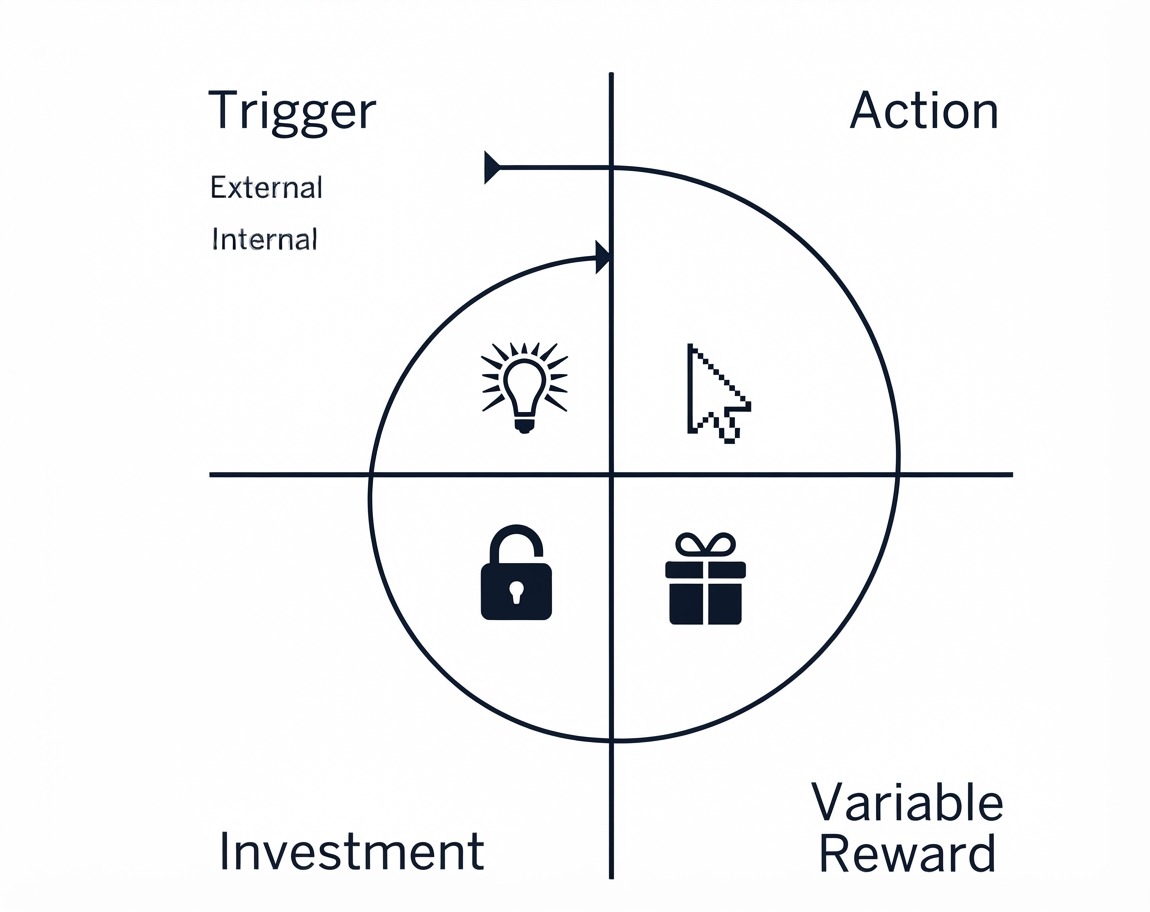
A four-stage cycle (trigger, action, variable reward and investment) designed to foster habit formation in technology products.
Dual Process Theory
A theory that explains how our brain operates through two distinct thinking systems. This framework is covered in depth in Daniel Kahneman’s book, Thinking, Fast and Slow.
System 1
Fast, automatic, intuitive and emotional thinking. It is responsible for the vast majority of everyday unconscious decisions and the main target of interventions based on *nudges*.
System 2
Slow, conscious, deliberative and logical thinking. It requires considerable cognitive effort and is activated by complex tasks.
Intrinsic motivation
A drive that comes from within the individual, motivated by personal interest, curiosity or inner satisfaction.
Extrinsic motivation
A drive propelled by external factors, such as the pursuit of rewards, social recognition or the avoidance of penalties.
Reward
A positive stimulus the user receives after performing an action, reinforcing the likelihood that they will repeat that behavior.
Variable reward
An element of unpredictability in the benefit obtained that significantly increases desire and repetition of the behavior.
Reward anticipation
The dopaminergic expectation generated in the brain before performing an action, acting as a powerful motivational engine.
Friction and Ability
Cognitive friction
The extra mental effort required of users to process information or make a decision in an interface, reducing their likelihood of converting.
Emotional friction
Negative feelings, such as distrust, fear or frustration, that block users and keep them from completing an action.
Functional friction
Technical or operational obstacles in the system, such as excessively long forms, broken links or slow loading times.
Cognitive overload
A situation that occurs when the volume of information or alternatives exceeds the human brain’s processing capacity.
Perceived effort
The user’s subjective assessment of how difficult a task is, shaping their willingness to start it.
Decision fatigue
The deterioration in the quality of choices after a long session of consecutive decision-making.
Capacity to act
An assessment of whether the user has the knowledge, time, money and resources needed to perform the expected behavior.
Interface clarity
The design of clean, understandable screens that minimize doubt and guide the user’s steps intuitively.
Cognitive simplicity
The practice of structuring key information so that it is quickly absorbed by System 1’s intuitive thinking.
Friction reduction
The systematic identification and removal of the psychological and technical barriers that slow down or halt the user’s flow.
Cognitive Biases
Unconscious mental shortcuts that underpin behavioral economics and make it possible to build effective strategies.
Cognitive bias
A pattern of systematic deviation from rational judgment that affects how information is perceived. Explore our guide to the main types of cognitive biases.
Anchoring bias
The tendency to give disproportionate weight to the first piece of information received, which is key in pricing.
Loss aversion
A principle showing that we feel the pain of a loss more intensely than the pleasure of an equivalent gain.
Confirmation bias
The unconscious tendency to seek out and interpret information that supports prior beliefs. Learn more in our article on confirmation bias in CRO.
Availability bias
The tendency to judge the likelihood of an event based on how easily similar examples come to mind.
Authority bias
The inclination to value the opinions of an expert or prominent figure more positively.
Scarcity bias
The tendency to perceive a product as more valuable when its availability in time or units is limited.
Halo Effect
A cognitive bias in which the positive perception of one characteristic of something or someone favorably influences the overall assessment of other unrelated attributes.

Framing effect
Shows that the exact way information is presented determines the user’s interpretation and response.
Endowment effect
The tendency to assign greater value to goods simply because we own them.
Status quo bias
A natural resistance to change that leads us to prefer that things remain as they are.
Social Influence
Social proof
A phenomenon in which people look to the behavior of others to validate their own decisions under uncertainty.
Social validation
External confirmation that a user seeks to reassure themselves that their choices are right. Analyzed in depth in our research on social bias.
Social norms
Implicit or explicit rules that dictate which behaviors are considered acceptable within a group of people.
Choice Design
Default options
Options preselected by the system that users tend to keep because of cognitive inertia.
Number of options
The number of alternatives presented; structuring them intelligently avoids overwhelming the user.
Analysis paralysis
A psychological block that a customer experiences when faced with an overload of alternatives, wiping out their ability to decide.
Contextual presentation
The dynamic adaptation of offers and content based on the user’s profile. A classic case study is the contextual personalization of Stranger Things.
User Experience (UX)
User Journey
A detailed map describing a customer’s entire path and interactions with a digital service.
Friction points
Steps in the journey where the user experiences confusion or doubt, preventing a successful conversion.
Usability
The degree of simplicity, effectiveness and speed with which users can interact with a digital environment.
Experimentation and Optimization
A/B Test
The simultaneous launch of two versions of a page to statistically measure which one generates a better response. Check out the main types of web A/B tests.
Multivariate test
The simultaneous evaluation of multiple elements on the same screen to identify their combined impact. You’ll find a step-by-step guide in our multivariate testing guide.
Statistical significance
A mathematical calculation showing that an experiment’s results reflect a real trend. You can use our A/B test significance calculator or download our Excel calculator.
Conversion optimization (Growth & CRO)
A methodological process focused on increasing the conversion rate using rigorous methods backed by data-driven optimization (CRO).
Behavioral Analytics
The collection and analysis of real behavior on digital platforms. A field being transformed by innovations such as synthetic users in CRO.
Habits and Retention
Habit formation
The structuring of repeated interactions that become automatic behaviors by combining motivation, ability and triggers.
User retention
A business metric that evaluates a digital product’s ability to keep its customers active over the long term.
Ethics and Responsible Design
Responsible design
An approach that evaluates the long-term psychological consequences of our interfaces, key during the validation of web experiments.
Dark patterns
Tricks and deliberately confusing interfaces designed to manipulate the user’s will and pervert digital ethics.
Specialized Tools
Advanced analytics platforms essential for measuring and optimizing user behavior.
Hotjar
A tool for analyzing behavior through heatmaps, session recordings and surveys. Visit Hotjar
Adobe Target
An enterprise solution for advanced personalization and large-scale testing. Check out our Adobe Target review or the comparison of Adobe Target vs Optimizely vs VWO.
AB Tasty
A platform focused on testing and customer experience optimization. Read the AB Tasty reviews.
Optimizely
A digital experimentation platform known for its power in segmentation and web development. Visit Optimizely
Crazy Egg
A tool for click maps and vertical scroll maps. Visit Crazy Egg
VWO (Visual Website Optimizer)
An integrated ecosystem for research, recordings and A/B tests. Visit VWO
Fogg Behavior Model Tool
An interactive conceptual resource for analyzing conversion failures. Visit Fogg Behavior Model Tool
Amplitude
An analytics platform focused on navigation paths and retention. Visit Amplitude
Mixpanel
A tool for detailed, real-time tracking of user actions and events. Visit Mixpanel
Behavioral Economics Guide
An international reference portal with studies on behavioral economics. Visit Behavioral Economics Guide
Persuasive Tech Lab
A Stanford research lab on persuasive technologies and ethics. Visit Persuasive Tech Lab