An effective CRO strategy starts by removing unnecessary friction from the interface. Many websites lose users because an excess of options increases cognitive load instead of delivering a personalized experience. In this article, we look at how to apply product personalization and behavioral design to improve your results. You’ll learn how to anticipate your users’ needs to maximize conversion and drastically reduce bounce rate, turning your sales funnel into a smooth, efficient flow.
Goal:
Increase Conversion Rate
Focus:
UX and Consumer Psychology
Level:
Advanced / Growth
CRO Strategy: How to Reduce Your Website Drop-Off Rate
- Introduction: The impact of friction on conversion
- Individuals > Segments: The key to product personalization
- Context vs. Data: Why averages mislead in UX
- Nudge, don’t push: Conversion optimization and psychology
- Interface persistence: Eliminating the “Filter Fest”
- The risk of Social Bias without contextual relevance
- Frequently Asked Questions about CRO Strategy and Personalization
- Conclusion: Data-driven design as a competitive advantage
Individuals > Segments: The Key to Product Personalization UX
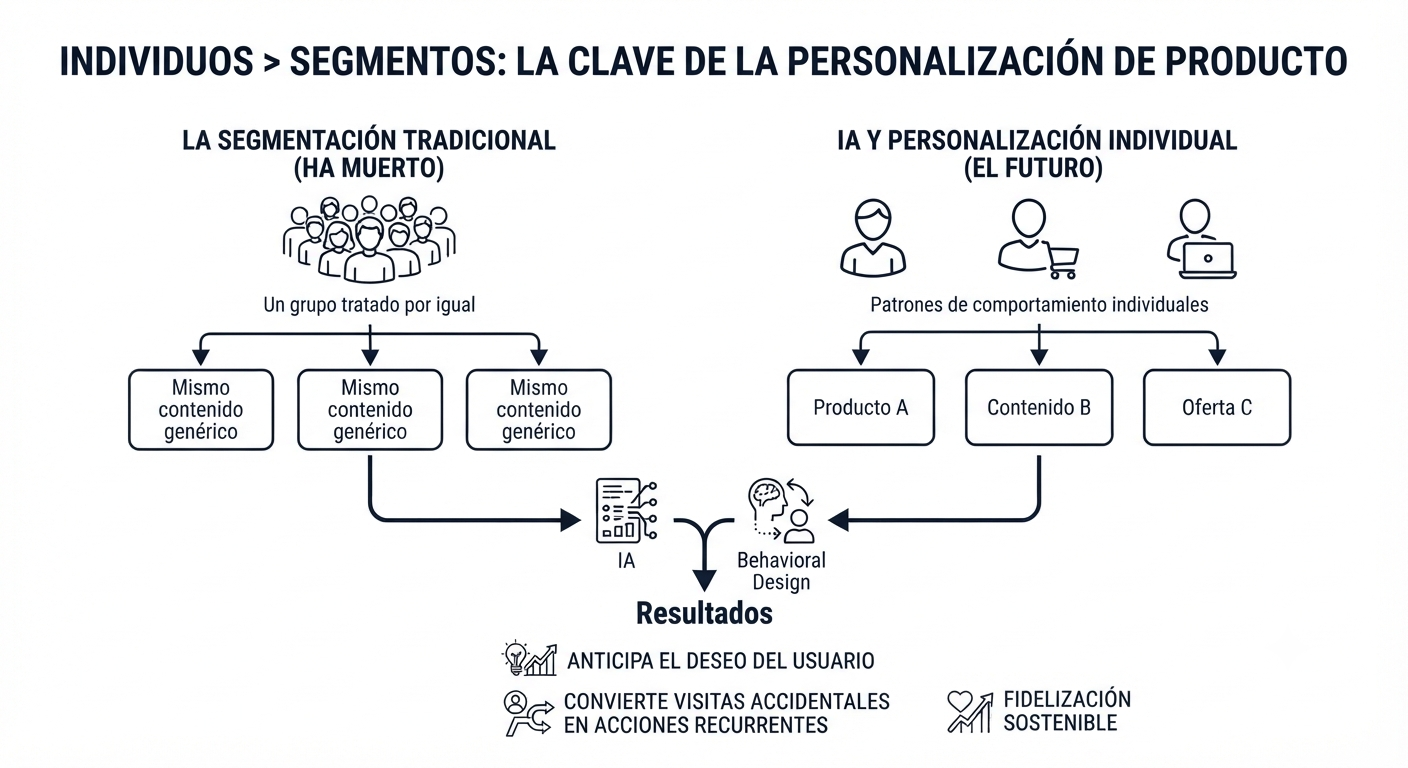 future of work in CRO. By predicting what users need before they even search for it, we apply the principles of Behavioral Design to turn accidental visits into repeat actions, achieving a level of loyalty that few tools can deliver on their own.
Context vs. Data: Why Averages Mislead in UX
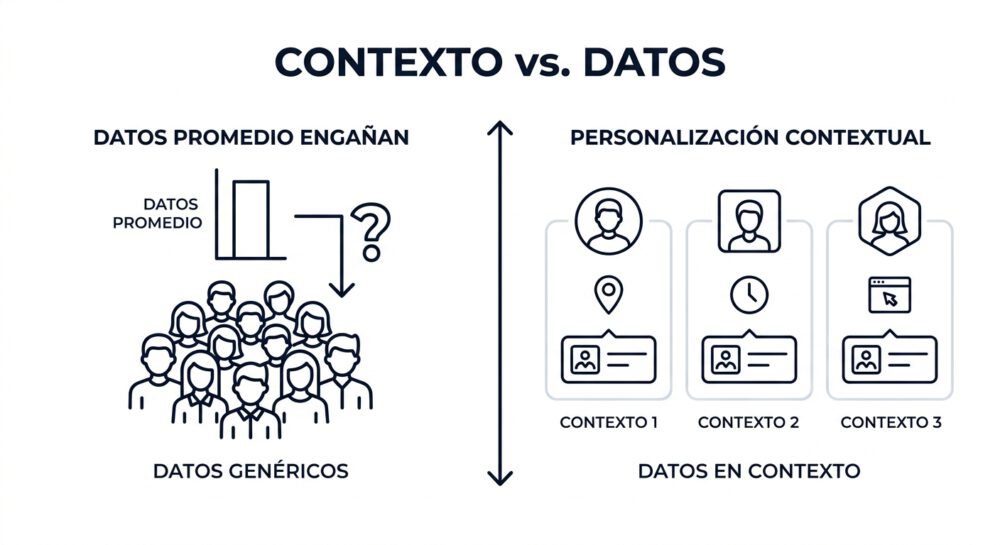
Relying on “average data” is the number one mistake limiting the scaling of a high-performance website. The problem with averages is that they hide reality: two users can take the same action for radically opposite reasons. As we explained in our CRO guide, understanding hidden intent is what separates market leaders from those who just run random experiments.
Advanced web personalization lets you adapt the interface to the real context. A user looking for a quick solution is not the same as one in a deep research phase. Delivering a hyper-relevant experience through personalization algorithms increases user lifetime value (LTV) and ensures every interaction is meaningful.
Nudge, Don’t Push: Conversion Optimization and Psychology
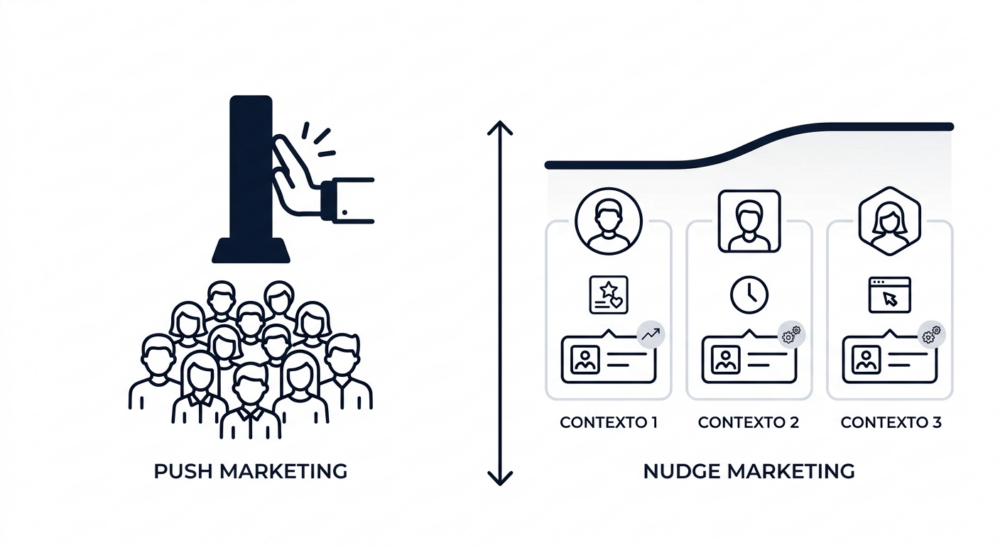
Nudge Marketing is the ultimate technique for reducing cognitive load without forcing users down a predetermined path. Instead of pushing aggressively, a smart CRO strategy guides users with small suggestions that improve the browsing experience.
When structuring your experiments, remember that choosing the right types of A/B tests is just as important as calculating A/B test duration with mathematical rigor to reach statistical significance. Don’t let confirmation bias cloud your results; success lies in measuring honestly, understanding user behavior and applying what you learn iteratively.
Interface Persistence: Eliminating the “Filter Fest”
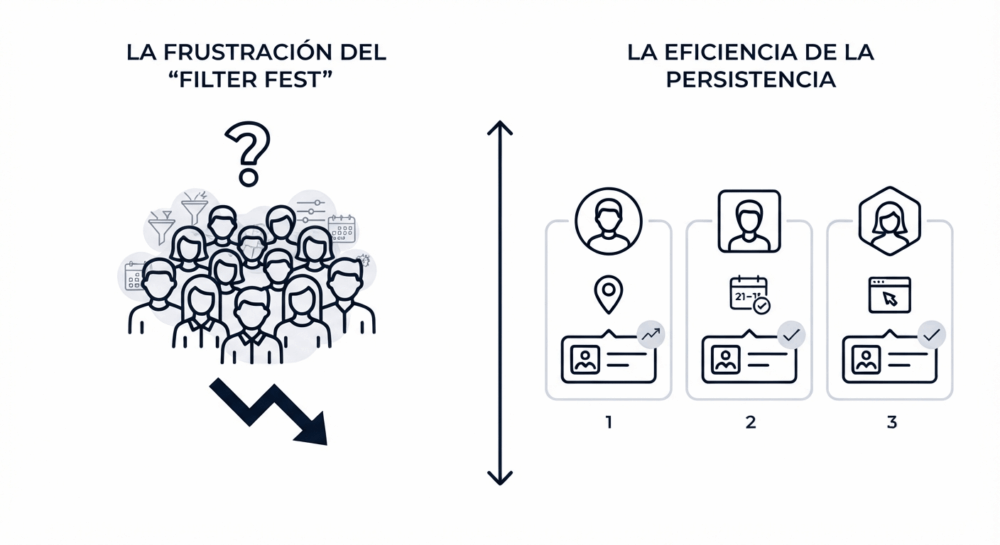
Forcing users to reconfigure their preferences every session is a direct cause of churn. An optimized user interface should remember high-inertia settings. When a user sets a preference, that information should persist in their profile for future sessions.
This improves retention and relies on proper web experiment validation. Design efficiency should be grounded in fast and slow thinking concepts, eliminating the unnecessary friction that appears when we force users to perform repetitive tasks within a digital platform.
Frequently Asked Questions about CRO Strategy and Personalization
What is a CRO strategy, really?
A CRO strategy is a systematic, data-driven process for improving a website’s conversion rate. It goes beyond cosmetic changes, focusing on removing friction by analyzing user behavior in order to maximize return on investment.
Why does product personalization improve conversion?
Product personalization is key to eCommerce UX. By reducing cognitive load and filtering out irrelevant options, we make the path to purchase easier. This is achieved through advanced filter optimization that adapts the interface to each user’s intent in real time.
How does behavioral design influence conversion?
Behavioral design uses psychological principles to guide users without forcing them. By aligning web architecture with human decision-making processes, we achieve a more natural conversion rate optimization, drastically reducing drop-off rates in critical flows.
When should synthetic users be used in a CRO project?
Synthetic users in CRO are ideal for auditing complex navigation flows or validating design hypotheses before exposing real traffic. This technique lets you test the robustness of a CRO strategy without putting your current metrics at risk.
How do I know if my A/B tests are reliable?
Reliability depends on statistical significance. It’s essential to calculate A/B test duration correctly to avoid false positives, and to stay alert to cognitive biases such as confirmation bias, which can distort how you interpret the data.
Conclusion: Data-Driven Design as a Competitive Advantage
Implementing a personalization architecture isn’t just a cosmetic improvement; it’s a technical necessity for any business aiming to scale its conversion rate. As the Airbnb Personalization case study highlights, the key is to move past averages and start treating users according to their individual context.
If you apply these eCommerce UX principles and remove friction through smart website filter optimization, you won’t just improve today’s metrics; you’ll build a lasting relationship of trust that sets your brand apart from the competition. Are you ready to take your CRO strategy to the next level? Don’t forget to audit your current flows, remove entry barriers and start testing today with a rigorous methodology based on real user behavior.
Latest posts

Stranger Things: A Masterclass in Contextual Personalization

Social Bias: 6 Real-Life Success Examples
The Risk of Social Bias Without Contextual Relevance
Although social bias is a powerful trigger, showing popular recommendations without personalization damages credibility. If you suggest “what others prefer” without considering what the current user needs, the system comes across as generic and unprofessional.
To mitigate risks and protect your CRO strategy, we suggest implementing synthetic users in your CRO audits. This lets you test new features and validate your design hypotheses without putting your real traffic at risk, ensuring that every change you make to your site delivers real value to the end user.