
When analyzing Contentsquare reviews in today’s enterprise market, it is clear that the platform has gone from being an option to becoming a standard. As one of the most robust enterprise digital analytics tools, the big question Growth teams face is not just its viability, but how to measure the revenue impact of UX errors using its advanced AI for website optimization. In this post, we break down the Contentsquare vs traditional analytics tools showdown from an evidence-based optimization perspective for highly complex environments.
Rating
Difficulty
Medium / Enterprise Data-Driven
Applicability
High / Strategic
Review Contents
Why Does Contentsquare Lead the Enterprise Digital Analytics Tools Market?
The Contentsquare platform has completely transformed data architecture by capturing the real “why” behind human behavior. If we look at Contentsquare reviews from experts and industry leaders, most highlight that, among all current enterprise digital analytics tools, it stands out for unifying technical performance with financial KPIs. This is essential when you implement a CRO and product personalization strategy, as it lets you validate hypotheses with surgical precision thanks to its advanced capabilities.
By plugging into any modern stack through advanced AI for website optimization, Contentsquare democratizes access to complex insights. However, to dominate the market in the Contentsquare vs traditional analytics tools comparison, it is vital to combine this technological potential with a behavioral design approach to CRO. This way, we make sure every finding obtained through AI for website optimization is fully understood through solid, scientific user psychology, optimizing ROI and answering the question of how to measure the revenue impact of UX errors in an automated way.
Contentsquare vs Traditional Analytics Tools: The Gap
The intense professional debate between Contentsquare vs traditional analytics tools, especially when compared with the limited models based exclusively on GA4 sessions, is a crucial point for any modern digital strategy. While traditional analytics tends to offer abstract, aggregated data, Contentsquare redefines the sector by providing granular, precise visibility into real user behavior.

Contentsquare’s technical superiority becomes fully evident when carrying out rigorous web experiment validation. In complex technical environments where other enterprise digital analytics tools lose track of navigation due to the asynchronous loading of modern SPAs (Single Page Applications), this platform stands out for maintaining full journey traceability. This level of detail ensures your tests rest on an impeccable statistical foundation, allowing you to make informed decisions about how to measure the revenue impact of UX errors.
By implementing the AI for website optimization built into Contentsquare, companies overcome the limitations of conventional analytics. If we consult Contentsquare reviews from senior analysts, it is clear that the competitive gap lies in the ability to turn raw data into financial insights. Faced with the eternal dilemma of Contentsquare vs traditional analytics tools, choosing the right platform is what separates brands that guess from those that optimize their results with absolute certainty.
How to Measure the Revenue Impact of UX Errors Accurately
For most product and Growth teams, figuring out how to measure the revenue impact of UX errors has historically been the most complex challenge in digital analytics. Contentsquare turns this obstacle into a competitive advantage by removing technical team bias, automatically assigning a direct monetary value to every friction point detected during navigation. This monetization capability is the fundamental difference when carrying out data-driven conversion optimization, as it lets you visualize the real cost of usability problems in the sales funnel.
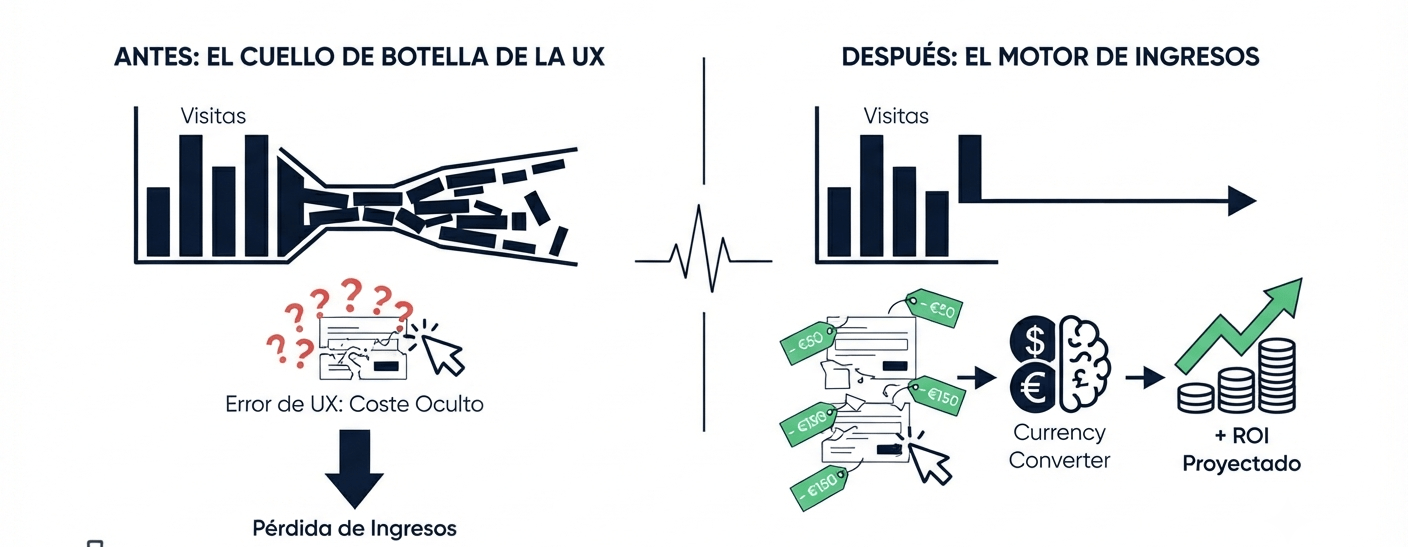
By mastering how to measure the revenue impact of UX errors, teams stop prioritizing tasks based on intuition or technical urgency and start shipping changes backed by a projected return on investment (ROI). This quantitative approach makes it dramatically easier to justify budgets to the finance department, turning the UX department from a cost center into a revenue engine. By combining this metric with AI for website optimization, companies can identify, quantify and mitigate pain points before they seriously affect the conversion rate.
In the eternal debate of Contentsquare vs traditional analytics tools, this monetization feature carries the most weight according to executives’ Contentsquare reviews. While other enterprise digital analytics tools offer vanity metrics, the ability to translate a form error or a frustrated click into lost revenue is, without a doubt, the most powerful tool for any large-scale financial optimization strategy.
The Artificial Intelligence Engine for Website Optimization
Contentsquare’s AI for website optimization, called Sense, is not simply a conventional analytics assistant; it is a powerful predictive engine designed specifically to mitigate the most common types of cognitive biases in business decision-making. By processing millions of user sessions at scale, this AI detects anomalies, hidden patterns and friction points that even the most experienced human analyst could accidentally overlook. This advanced analytical capability is the perfect complement for implementing advanced web personalization strategies, making it possible to deliver highly relevant 1:1 experiences in real time.
When we evaluate its performance within the framework of enterprise digital analytics tools, this technology stands out for its proactivity. While traditional analytics tools require constant manual configuration to uncover issues, Contentsquare’s AI for website optimization automatically alerts teams to significant changes in user behavior. This is vital when we ask how to measure the revenue impact of UX errors, since the system not only identifies the error but quantifies it financially before it affects the business’s overall profitability.

As the most recent Contentsquare reviews point out, using this AI changes the rules of the game in the Contentsquare vs traditional analytics tools comparison. By drastically reducing the time spent cleaning and processing data, teams can focus on strategic execution and optimizing their conversion funnels. In an increasingly competitive digital ecosystem, integrating this technology is the fastest route to a sustainable advantage, grounding every site interaction in data processed with a scientific precision that conventional platforms simply cannot replicate.
Final Verdict: Is the Investment Worth It?
After an in-depth analysis of the perspectives shared by product leaders and digital growth experts, we can say that this platform is a strategic bet for organizations operating at scale. Beyond its technical features, its real value lies in its ability to align the creative team’s goals with the financial results leadership demands.
Unlike other analytics solutions that stay on the surface of reports, this software acts as a backbone within the company’s technology ecosystem. The competitive advantage is measured not only by the richness of its data, but by how quickly teams can turn those insights into concrete actions that protect profit margin.
Compared with conventional measurement methods, this suite stands out for its proactive approach. While other tools require constant manual configuration, here automation lets the optimization team spend its time on strategy rather than data cleaning. If your organization is already running complex experiments or multivariate tests, having this level of visibility is the logical step to ensure that every change on the website is justified by a real impact on revenue. Ultimately, it is a key piece for any brand seeking methodological maturity and a sustainable advantage in the digital market.
Frequently Asked Questions About the Platform
What sets this tool apart from other options on the market?
The main distinction is its focus on the complete digital experience. While many platforms limit themselves to charts about traffic, this solution focuses on understanding how visitors interact with interface elements. This makes it possible to identify blockers in the customer journey that would otherwise be invisible to analytics teams.
How does implementation affect my website’s loading speed?
The architecture is designed to be extremely lightweight. By using smart tags that load asynchronously, the performance impact is minimal. Engineers usually value this positively, as it does not compromise Core Web Vitals standards or the end user’s browsing experience.
Do I need a dedicated technical team to get results?
Not necessarily. Although having a technical profile helps set up the most advanced integrations, the platform is designed so that product managers and marketing specialists can access key information autonomously. The interface is intuitive and lets you draw valuable conclusions without constantly depending on the IT department.
How does this tool help prioritize development?
It helps by removing guesswork from decision-making. With clear visibility into where friction points occur and how much money each problem represents, product managers can organize their roadmap based on real business impact, setting aside changes driven solely by personal opinions.
Does it integrate with my current software ecosystem?
Yes, the suite is highly compatible. It connects seamlessly with the most widely used marketing, experimentation and project management tools in the professional environment. This connectivity lets data flow between departments, creating a single source of truth for the entire organization.
How does it guarantee the privacy of user data?
Security and regulatory compliance are core pillars. The tool includes advanced data anonymization and masking features, ensuring that no sensitive end-user information is captured or displayed, while strictly complying with international personal data protection standards.
Transparency note: At IdearioDigital we maintain our editorial independence. This review is based exclusively on our technical audit and market analysis. We receive no compensation, commission or financial benefit from Contentsquare or from any other platform mentioned in this article.
You can explore its capabilities directly on its official website: