Review Summary: AB Tasty Enterprise Review
An in-depth technical analysis and roundup of the main AB Tasty reviews in the enterprise market. We take a close look at the experimentation platform, breaking down its AI-powered automation capabilities, advanced omnichannel traffic allocation algorithms and its real-world performance on complex web architectures. If you want to compare the best enterprise-grade CRO tools on the market, this analysis breaks down its technical viability against other leading suites in the ecosystem.
Rating
Difficulty
Medium / Agile Enterprise
Applicability
Immediate
Review Contents
- What Is AB Tasty and How Does It Work in the CRO Stack?
- AB Tasty vs. Traditional A/B Testing: The Enterprise Gap
- The Impact of AI on AB Tasty’s Advanced Personalization
- Multi-Armed Bandit Algorithms vs. Standard A/B Testing
- Technical Weaknesses: The Platform’s Limits
- Final Verdict and Expert AB Tasty Reviews
- AB Tasty Suite FAQs
What Is AB Tasty and How Does It Work in the CRO Stack?
AB Tasty is a conversion rate optimization, experimentation and feature rollout platform designed for the global market. Unlike tools that work by injecting basic visual scripts into the customer’s browser, this suite stands out for its hybrid model, which combines the agility of Client-Side with the architectural robustness of its Server-Side solution (Flagship). In today’s ecosystem, where enterprises rigorously evaluate different CRO tools, this solution competes head-to-head on features, as we analyze in our technical comparison of Adobe Target vs Optimizely vs VWO.
At the infrastructure and web engineering level, the platform implements a single smart tag optimized to minimize latency. When analysts evaluate optimization technologies, AB Tasty reviews agree on the advantage of its infrastructure, since it processes audience targeting rules and visual variations efficiently without penalizing page load speed.
For organizations looking for a connected ecosystem, the tool integrates natively with leading analytics solutions such as Google Analytics 4, Amplitude or Contentsquare. The result is a continuous flow where quantitative data is immediately turned into controlled experiments in real time, building an agile and mature experimentation environment.
AB Tasty vs. Traditional A/B Testing: The Enterprise Gap
The evolution of enterprise optimization programs demands tools that overcome the operational limitations of the past. When analyzing the AB Tasty vs traditional A/B testing scenario in detail, it becomes clear that basic solutions built on rigid visual plugins are no longer viable on modern web architectures built with Vue.js, Next.js or React, because of flicker issues that damage the user experience and limit scope compared with the various advanced types of web A/B tests.
The platform’s value proposition versus a traditional A/B testing approach breaks this inertia through differentiating technical capabilities:
- Advanced Multivariate Testing (MVT): Lets you set up complex factorial designs without ad-hoc development. When running this type of test under a rigorous multivariate testing guide, teams can identify exactly which combination of elements generates the biggest increase in net revenue.
- Feature Management (Feature Flags): With its advanced architecture, software engineering teams can hide or activate entire features under controlled parameters, mitigating risk in production.
- Flicker Effect Mitigation: Through an optimized rendering engine and advanced asynchronous loading, the platform prevents visual delay, protecting critical Core Web Vitals metrics such as Largest Contentful Paint (LCP).
The Impact of AI on AB Tasty’s Advanced Personalization
The core of the platform’s automation relies on machine learning and artificial intelligence algorithms applied to predictive segmentation. Deploying an advanced personalization strategy requires instantly processing a matrix of contextual user signals. This paves the way toward a true AI and web personalization infrastructure capable of analyzing current browsing patterns, estimated purchase intent, visit frequency and geolocation.
By cross-referencing these variables, the artificial intelligence dynamically classifies each visitor into predictive behavioral segments. The real value of advanced personalization based on predictive models is that it assigns the exact experience that maximizes the probability of conversion, on autopilot. This drastically reduces the operating cost of Growth teams and lets brands engage customers with real-time hyper-personalized offers that increase customer lifetime value (LTV).
Multi-Armed Bandit Algorithms vs. Standard A/B Testing
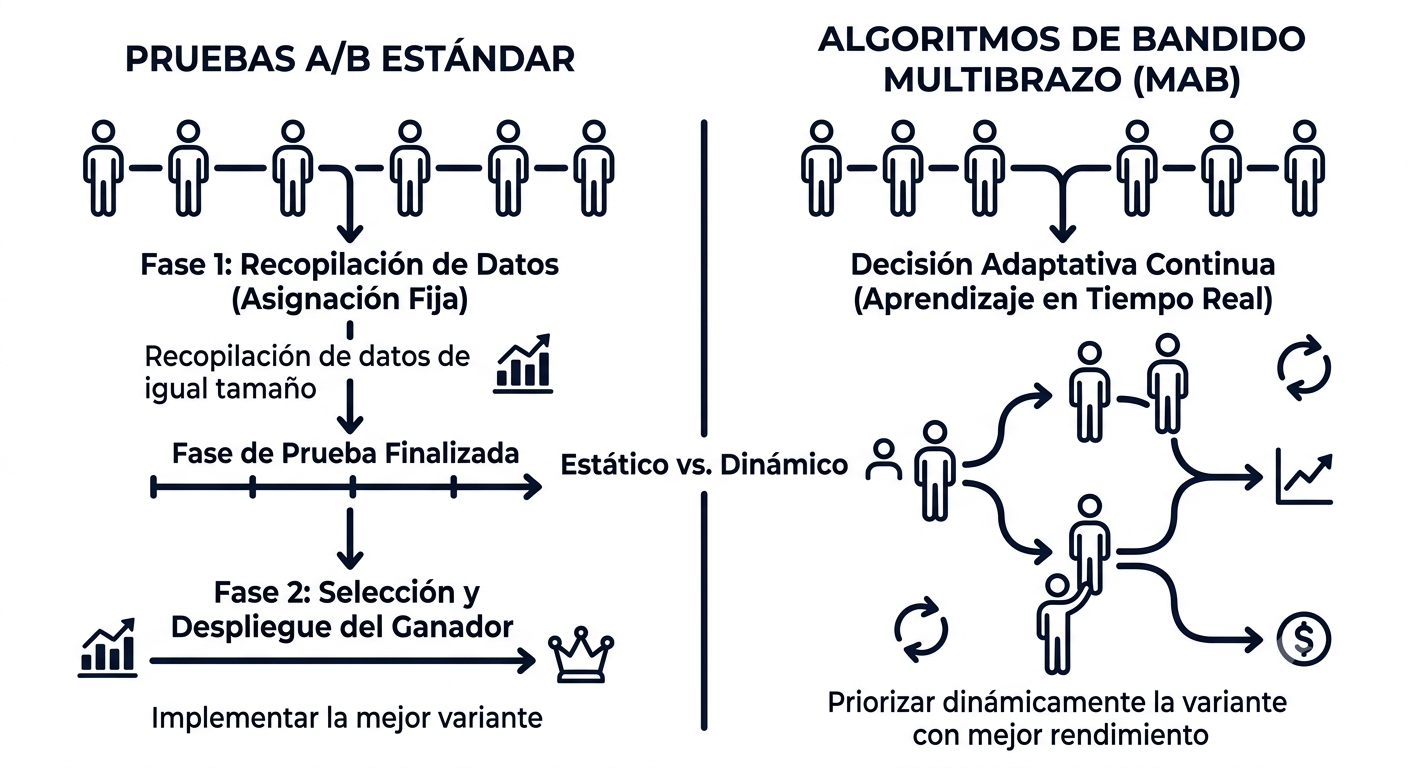
In enterprise-level digital optimization, opportunity cost is a critical variable. Keeping a classic test running in which one of the variants performs poorly destroys valuable revenue every single day. Understanding in depth the difference between multi-armed bandit algorithms and traditional A/B testing is essential to balance statistical learning with the business’s immediate profitability.
The traditional approach distributes traffic symmetrically and immutably (50/50), which makes it necessary to use tools to calculate A/B test duration mathematically before launch. By contrast, when analyzing the difference between multi-armed bandit algorithms and standard A/B testing, what stands out is the use of mathematical models for dynamic traffic allocation (Multi-Armed Bandit), which automatically adjust the percentages, progressively shifting traffic toward the winning option and protecting the business’s cash flow during short-lived seasonal campaigns.
| Technical Criterion | Standard A/B Test (Traditional) | Multi-Armed Bandit Algorithm |
|---|---|---|
| Traffic Distribution | Static and fixed from start to final close. | Dynamic. Readjusts percentages in real time. |
| Primary Goal | Pure statistical validation with high confidence levels. | Maximizing conversion volume and revenue. |
| Risk Mitigation | None. Exposes traffic to losing variants at a fixed rate. | Maximum. Automatically reduces exposure to poor variants. |
Technical Weaknesses: The Platform’s Limits
To build a transparent audit based on the main AB Tasty reviews in the industry, it is essential to break down the technical limitations teams experience when implementing the solution at scale, compared with other open-source CRO tools or monolithic solutions.
- Server-Side Complexity: Moving to advanced experimentation through its SDK requires high technical maturity and dedicated development cycles from the software engineering team.
- Traffic Volume Dependency: Dynamic allocation algorithms and advanced personalization modules lose analytical effectiveness on corporate websites with low transactional traffic, since the mathematical models take longer to converge.
- Advanced Adoption Curve: Although the visual editor is intuitive for simple cosmetic tasks, making full use of the data layer and API integrations requires specialized technical training to ensure proper web experiment validation.
Final Verdict and Expert AB Tasty Reviews
After analyzing its components and its flexibility in agile development environments in detail, the consensus among AB Tasty reviews from digital optimization leaders positions it as one of the best and most balanced CRO tools in the global Enterprise market. It doesn’t require massive, complex infrastructure to start delivering a positive return on investment (ROI).
AB Tasty reviews from product directors highlight its ability to unify marketing and development under a single technical console, enabling a continuous flow of tests and safe deployments.
“AB Tasty’s greatest strength lies in its ability to unify the agility requirements of the marketing team with the technical performance and deployment control demands of engineering departments.”
AB Tasty Suite and Advanced Optimization FAQs
What do users think about AB Tasty’s ease of use and potential?
AB Tasty reviews from optimization specialists unanimously highlight that its visual editor and user interface are among the most intuitive in the enterprise-level market. This makes it much easier for digital marketing profiles or product managers to configure and launch simple experiments without constantly depending on software engineering development cycles, drastically speeding up the day-to-day workflow of growth teams.
However, digging deeper into AB Tasty reviews from more technical profiles, they positively note that this ease of use at the visual layer does not limit custom code injection capabilities (JS/CSS) or detailed control over Data Layer variables, making it a highly balanced solution for multidisciplinary organizations.
What is the benefit of analyzing AB Tasty vs traditional A/B testing in complex ecommerce environments?
When closely evaluating the AB Tasty vs traditional A/B testing scenario in e-commerce, the main benefit lies in control over technical performance and execution speed. While a traditional testing approach frequently breaks the logic of dynamic carts, payment gateways and Single Page Applications built on modern JavaScript frameworks, this platform handles those variables natively.
In addition, the competitive gap in an AB Tasty vs traditional A/B testing comparison shows in the ability to run hybrid experiments. This lets you modify visual elements in the browser (Client-Side) while at the same time validating deep structural changes (such as product recommendation algorithms) on the server (Server-Side) through its Flagship module, completely avoiding junk code and rendering errors.
How does the difference between multi-armed bandit algorithms and A/B testing affect campaign budget and ROAS?
The difference between multi-armed bandit algorithms and standard A/B testing has a direct, measurable impact on return on ad spend (ROAS) and on controlling your business’s opportunity cost. In a conventional static test (standard A/B), traffic is split strictly 50/50 until the experiment ends, which means thousands of high-converting paid-traffic users will keep seeing a losing variant for weeks, destroying potential revenue.
By contrast, the key difference between multi-armed bandit algorithms and A/B testing is that bandit-based models (Multi-Armed Bandit) continuously monitor early conversions. As soon as the algorithm detects a winning trend, it automatically reallocates traffic percentages in real time. That way, it diverts most of your visits and spend toward the most profitable option, minimizing the financial losses associated with low-performing variants.
What technical and infrastructure requirements does advanced personalization demand on this platform?
To successfully deploy advanced personalization strategies based on predictive intent and machine learning, the suite requires a clean, well-structured data ecosystem. The fundamental technical requirement is properly unifying your website’s Data Layer, ensuring that all user interaction events (clicks, add-to-carts, scrolls) are transmitted seamlessly to the tool.
Advanced personalization truly thrives when it is connected natively to the company’s tech stack, such as a Customer Data Platform (CDP) or a corporate CRM. This allows the platform’s artificial intelligence models to process not only real-time contextual signals but also the customer’s actual transaction history, delivering one-to-one hyper-personalized experiences in real time.
How does this platform position itself within the ecosystem of CRO tools for large enterprises?
In today’s market for enterprise solutions, the suite sits at the high end of global CRO tools thanks to its focus on agility and Time-to-Market. Unlike other massive enterprise systems that require months of heavy technical implementation and mandatory external consulting, this alternative lets you set up a robust experimentation program in weeks.
When auditing the best CRO tools for omnichannel environments, this platform stands out for offering a solid bridge between the agile needs of commercial optimization teams and the infrastructure performance, data security and deployment control demands of modern software engineering departments.
Conclusion: The Benchmark Infrastructure for Experimentation
Implementing this platform in the enterprise digital ecosystem is a decisive step toward methodological maturity in your optimization work. By combining the flexibility of an intuitive editor with the technical robustness of dynamic traffic allocation, it positions itself at the forefront of today’s CRO tools, ensuring sustainable, scalable growth for the digital business.